 When we reported back in February that Google Goggles -- Google's augmented reality app for Android -- would be able to translate text on the fly using your phone's camera, we didn't know it was going to be available so soon! Our friend (and former DLS editor) Brad Linder has posted a video of the new translation feature in action over at mobiputing. Brad explains that once you've snapped a pic of whatever you're trying to translate, you can swipe the screen to select the specific text to target. Apparently, it sometimes takes a few tries to get Google Goggles to recognize your photo as text, but once it does, it works about as well as you'd expect Google Translate to work. For a glimpse at Google Goggles in action, check out the video after the jump.

1 / 3

Caption Text
2 / 3

Caption Two
3 / 3

Caption Three margin testing

Friday, May 7, 2010
Google Goggles now translates text using your phone's camera
http://www.downloadsquad.com/2010/05/07/google-goggles-now-translates-text-using-your-phones-camera/
When we reported back in February that Google Goggles -- Google's augmented reality app for Android -- would be able to translate text on the fly using your phone's camera, we didn't know it was going to be available so soon! Our friend (and former DLS editor) Brad Linder has posted a video of the new translation feature in action over at mobiputing. Brad explains that once you've snapped a pic of whatever you're trying to translate, you can swipe the screen to select the specific text to target. Apparently, it sometimes takes a few tries to get Google Goggles to recognize your photo as text, but once it does, it works about as well as you'd expect Google Translate to work. For a glimpse at Google Goggles in action, check out the video after the jump.
When we reported back in February that Google Goggles -- Google's augmented reality app for Android -- would be able to translate text on the fly using your phone's camera, we didn't know it was going to be available so soon! Our friend (and former DLS editor) Brad Linder has posted a video of the new translation feature in action over at mobiputing. Brad explains that once you've snapped a pic of whatever you're trying to translate, you can swipe the screen to select the specific text to target. Apparently, it sometimes takes a few tries to get Google Goggles to recognize your photo as text, but once it does, it works about as well as you'd expect Google Translate to work. For a glimpse at Google Goggles in action, check out the video after the jump. Thursday, May 6, 2010
Free digital textbooks approved by California
http://www.techlearning.com/article/29720
May 6, 2010
Five digital textbooks from CK-12 Foundation have recently met 100% of the California content standards for their respective courses. The foundation provides free, up-to-date, standards-aligned digital textbooks.
The five CK-12 FlexBooks now available for access by California educators athttp://www.clrn.org/FDTI/index.cfm are: CK-12 Probability and Statistics (Basic), CK-12 Probability and Statistics (Advanced), CK-12 Biology I (rev), CK-12 Earth Science (rev), and CK-12 Life Science (rev).
As the Foundation expands the reach of its quality open-source content across the nation, it has been working to align FlexBook content with the standards of many of the 50 states. For more information, visithttp://ck12.org/
电子商务网站用户分析
http://webdataanalysis.net/web-quantitative-analysis/e-commerce-user-analysis/
当用户在电子商务网站上有了购买行为之后,就从潜在客户变成了网站的价值客户。电子商务网站一般都会将用户的交易信息,包括购买时间、购买商品、购买数量、支付金额等信息保存在自己的数据库里面,所以对于这些用户,我们可以基于网站的运营数据对他们的交易行为进行分析,以估计每位用户的价值,及针对每位用户的扩展营销(Lead Generation)的可能性。
评价用户价值的指标
对于评价指标的选择这里遵循3个原则:
- 指标可量化:没办法,要做定量分析,这个是最基本的前提;
- 尽可能全面:根据底层数据选择尽可能多的可以获取的指标,这样能够从多角度进行分析和评价;
- 线性独立:即指标间尽量保持不相关。比如如果选择用户的购买次数和总消费额,那么一定是购买次数越多的用户总消费额越高,也就是导致了评价维度上的重合,而选择购买次数和平均每次交易额可以避免这种相关性产生的弊端。
根据以上几个原则选取了以下几个指标(同样根据网站的特征选取合适的统计时间段):
- 最近购买时间:用户最近一次购买距当前的天数;
- 购买频率:用户在这段时间内购买的次数;
- 平均每次交易额:用户在这段时间内的消费总额/购买的次数;
- 单次最高交易额:用户在这段时间内购买的单词最高支付金额;
- 购买商品种类:用户在这段时间内购买的商品种类或商品大类。
用户评价模型的展示
一样的,也可以用雷达图进行展示,同样也使用离差标准化的方法对每个指标进行消除度量单位的10分制评分。这里具体的方法就不再重复介绍了,请参照——网站用户忠诚度分析这篇文章。下面是一个雷达图的示例:
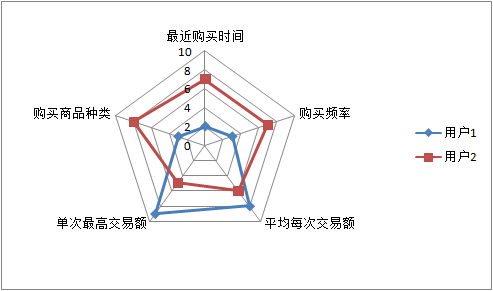
通过这个雷达图,我们可以读到比用户忠诚度更多的信息。图中的上面3个指标——最近购买时间、购买频率和购买商品种类可以用来评价用户的忠诚度,而下面的2个指标——平均每次交易额和单词最高交易额可以用来衡量用户的消费能力。如上图,用户1虽然购买频率和购买的广度不高,但其消费的能力较强,而用户2是频繁购买用户,对网站有一定的忠诚度,但其消费能力一般。所以图形的上半部分面积较大的用户拥有较高的忠诚度,而下半部分面积较大的用户具有更高的消费能力。这两类用户都是网站的有价值客户,但由于其类型的不同,在营销策略上可以分开对待。
用户交易行为分析的意义
- 发现网站的高价值客户(VIP),为客户关系管理(CRM)及保持有价值客户提供支持;
- 发掘网站的可发展用户,对于一些新客户或潜力客户进行针对性营销;
- 及时发现可能流失的客户,及时采取有效措施;
- 根据用户交易行为细分客户群,实施有针对性的营销策略。
Wednesday, May 5, 2010
China Unaffected by Google - Ecommerce Sales Expected to Rise by 90%
http://www.prnewswire.com/news-releases/china-unaffected-by-google---ecommerce-sales-expected-to-rise-by-90-92873419.html
BEVERLY HILLS, Calif., May 5 /PRNewswire/ -- March 2010 was a very interesting month for China. The same week that Google.com was officially blocked by the Chinese republic, PayPal entered into an agreement with China UnionPay (CUP),China's bankcard association, to allow Chinese consumers to use PayPal to shop online. PayPal also announced plans to expand its workforce in Asia to 2,000 by the end of the year 2010.
"Ecommerce sales have exploded over the past decade," said Todd Cowle, senior analyst with Shanghai-based China Market Research Group. "We expect to see 90% growth again this year because far-eastern labor, spare parts, and manufacturing continue to cost 1/10th of the western world price."
China's online shopping and ecommerce sales increased from $21.4 billion to $36.6 billion USD during the previous fiscal year and according to the China's Internet Network Information Center (CINIC), the numbers are only expected to increase.
The CINIC recently revealed the number of internet users in the world's most populous country jumped 28.9% in 2009 to 384 million, which is more than the entire population of the U.S. – China's dot cn domain registrations for the single month of March 2010 were 8,444,196.
According to Beryl Zyskind, an authority internet watchdog group reported in its recent 'internet trend' report the amazing growth of China's online activity. China's larger ecommerce sites like Bigboxstore.com sell every day products and accessories like mobile phones, laptops, spy gadgets and beauty products for a fraction of the USA costs.
One reason behind the growth has been that retailers have found products not only cheaper, but of higher quality. "Where can you buy a Wifi phone similar to the iPhone or Blackberry with TV and dual sim capabilities for $60?" asks Daniel Cohen, a trending expert from Israel who recently purchased 2 quality wifi phones from Chinasaledeal.com for a total of $120.
Much of China's ecommerce growth is being driven by a combination of both western and younger buyers. China Market Research Group stated that users in China between the ages of 13 and 28 spend 20 hours a week online on average, compared with 12 hours a week in the U.S. The theory is that as more of the Chinese population and local districts are exposed to the internet, ecommerce sales are expected to continue to rise.
Monday, May 3, 2010
End of the Desktop? Google Backs WebGL | Linux Magazine
http://www.linux-mag.com/id/7764/?utm_source=feedburner&utm_medium=feed&utm_campaign=Feed%3A LinuxMagazine %28Linux Magazine%3A Top Stories%29&utm_content=Google Feedfetcher
Stick a fork in the desktop, it's done! Recently Google demoed a port of Quake II to WebGL and HTML5, showing that even first person shooters are suitable applications to run in the browser. While the tide isn't going to turn all at once, it seems more likely than ever that a browser-based desktop is a viable option and ultimately the way many users will experience all applications.
妙用 Google 畅游世博会
2010年5月1日,上海世博会开园仪式在上海世博中心举行,世博会正式开始运营,并对外开园,为方便大家了解世博会,日前,谷歌地图推出了"妙用 Google,畅游博览会"的专题页面。该专题分为三个模块,第一部门是展馆介绍,同时还把场馆按照区域和类型分类,并在卫星地图上显示各个展馆的位置和名称,让用户能方便找到相应的场馆。第二部分是每日活动,用户可以选择日期,查看世博会每天的演出、表演和活动信息和地点。第三部门是世博会的历史,从1851年的伦敦世博会一直到现在,从这个世博会历史介绍中,我第一次知道,1999年昆明也办过世博会,不知道那次为什么那么低调,而现在这次又为什么这个高调。
另外,在Google 3D模型库中也有一些世博会场馆的3D模型,可以在Google Maps和Google Earth中使用,也值得一看。
Friday, April 30, 2010
Zen Cart FAQs - How do I configure for Canadian Taxes?
http://tutorials.zen-cart.com/index.php?article=75
Vendors operating in Canada need to accomodate numerous tax configurations to support proper tax collection on sales to customers in provinces where they are registered to sell. There's a Federal GST , HST, and provincial PST/RST.
Tax Zones / Rates configuration can be a little confusing at times, as the terms are easily and accidentally swapped ... by mistake... thus it's sometimes hard to follow the process through completely.
Hopefully this short article will help clarify.
Some contents originally written by Peter Mosier
Revised for clarity by drbyte (drbytezen AT yahoo DOT com)
=========================
Understanding Terminology
=========================
TAX CLASS = A setting assigned to PRODUCTS and to SHIPPING that's used to calculate final taxes.
TAX ZONE = A regional setting used to help determine tax rates by geography.
TAX RATE = A rate calculated by combining a product's tax class and shipping zone with the relevant tax percentage.
Zen Cart uses SHIPPING ADDRESS to determine appropriate taxes, i.e. which TAX ZONE you are shipping into. NOTE: this is the shipping address, and *NOT* the billing address.
A TAX RATE is determined by comparing SHIPPING ADDRESS to the Tax ZONE set up for the TAX RATE; and also by Tax Class assigned to each product.
You can only assign ONE TAX CLASS to a product.
In many stores, you will only have one TAX CLASS (GST/HST/PST) since all goods are either taxable or non-taxable.
When would you use different rates? One example would be if, say, CLOTHES were taxed at a different rate than BOOKS which are in turn different from DVDs. You could create a different TAX CLASS for each family ("class") of product in that case.
In the following examples, we will be dealing with only ONE tax CLASS for products.
You likely want the GST for SHIPPING to show up seperately, so we will make a separate "TAX CLASS" for "GST on Shipping".
========= PROBLEMS:
=========
The method below shows the GST and PST totalled together on the same line (see sample output below).
Having said that, the only problem is that the two taxes are summed together onto one line.
However, the GST number is displayed, and the percentages (rates) used are displayed, and nothing is hidden, so I believe that this will be acceptable according to Federal & Provincial Gov't requirements (but I AM NOT AN ACCOUNTANT!!!!).
**************************************************
Best part is: IT DOESN'T REQUIRE ANY CONTRIBUTIONS!!!!! Just a careful setup of the zones.
**************************************************
===================
Step-by-Step SETUP:
===================
STEP (1): Set the location for your store:
Configuration --> My Store
- Country: Canada
- Zone: Ontario
STEP (2): Create the "Tax Zones". The are geographical regions where a particular set of tax laws applies
Locations/Taxes --> Zones Definitions
Create the Zone for all of Canada
- Zone Name: Canada GST Zone
- Description: GST (except Eastern Canada: NS, NB, NL)
Now click on the newly created "Canada GST Zone" row to drill down one level to "Sub Zones"
Click INSERT to create 10 new sub-zones, one at a time:
- Country: Canada; Zone: Alberta
- Country: Canada; Zone: British Columbia
- Country: Canada; Zone: Manitoba
- Country: Canada; Zone: Northwest Territories
- Country: Canada; Zone: Nunavut
- Country: Canada; Zone: Ontario
- Country: Canada; Zone: Prince Edward Island
- Country: Canada; Zone: Quebec
- Country: Canada; Zone: Saskatchewan
- Country: Canada; Zone: Yukon Territory
Click on "BACK" to go up one level.
Now create the Ontario Provincial Tax Zone:
Click Insert
- Zone Name: Ontario PST Zone
- Description: PST (only when shipping to Ontario)
Now click on the newly created "Ontario PST Zone" row to drill down one level to "Sub Zones"
Click INSERT to create new sub-zone:
- Country: Canada
- Zone: Ontario
Click on "BACK" to go up one level.
Now create the HST Tax Zone:
Click Insert
- Zone Name: Eastern Canada - HST Zone
- Description: NS, NB, NL
Now click on the newly created "HST Zone" row to drill down one level to "Sub Zones"
Click INSERT to create new sub-zone:
- Country: Canada; Zone: Nova Scotia
- Country: Canada; Zone: New Brunswick
- Country: Canada; Zone: Newfoundland
Do NOT create a separate Tax ZONE for Shipping. You will simply use the "Canada" tax zone for the GST Shipping tax CLASS (below).
*** Important: this means that SHIPPING GST will only be charged to destinations within Canada,
*** but NOT charged on exports.
*** According to Canada Customs & Revenue Agency (1-800-959-5525), you do *NOT* charge GST
*** on the shipping fee for EXPORTS.
STEP (3): Create the "Tax Classes"
Note: You can only assign ONE Tax CLASS to a product.
But since we want shipping GST to show up separately, we will make a seperate Tax CLASS just for it.
Locations/Taxes --> Tax Classes
create TWO (2) tax classes:
- Tax Class Title: GST/HST/PST Class
- Description: All taxable goods
- Tax Class Title: GST on Shipping
- Description: GST on shipping within Canada
STEP (4): TAX RATES
Here is where it all comes together: Tax Rates.
Tax RATES associate Tax ZONES & Tax CLASSES to determine the correct Tax Rate.
HINT: The "DESCRIPTION" is what shows up on the invoice, so use it judiciously!!!!!!!!!!!!!
Locations/Taxes --> Tax Rates
create SIX (6) Tax Rates:
- Tax Class Title: GST/PST/HST Class
- Zone: Canada GST Zone
- Tax Rate (%): 6.0000
- Description: 6.0% GST#99999 99999 RT0001
- Priority: 1
/*HINT: Insert your GST# as part of DESCRIPTION and it will show up on invoice !!!
/*HINT: Leave PRIORITY at "1" for a non-cumulative tax (i.e. Ontario)
- Tax Class Title: GST/PST/HST Class /* HINT: Yes, this is the same one you just used
- Zone: Ontario PST Zone
- Tax Rate (%): 8.0000
- Description: 8.0% PST (Ontario)
- Priority: 1
/*HINT: Leave PRIORITY at "1" for a non-cumulative tax (i.e. Ontario)
but change to "2" for cumulative tax (i.e. You are a Quebec store)
- Tax Class Title: GST/PST/HST Class /* HINT: Yes, this is the same one you just used
- Zone: HST Zone
- Tax Rate (%): 14.0000
- Description: 14% HST#R99999 9999 RT0001
- Priority: 1
Tax Zones / Rates configuration can be a little confusing at times, as the terms are easily and accidentally swapped ... by mistake... thus it's sometimes hard to follow the process through completely.
Hopefully this short article will help clarify.
Some contents originally written by Peter Mosier
Revised for clarity by drbyte (drbytezen AT yahoo DOT com)
=========================
Understanding Terminology
=========================
TAX CLASS = A setting assigned to PRODUCTS and to SHIPPING that's used to calculate final taxes.
TAX ZONE = A regional setting used to help determine tax rates by geography.
TAX RATE = A rate calculated by combining a product's tax class and shipping zone with the relevant tax percentage.
Zen Cart uses SHIPPING ADDRESS to determine appropriate taxes, i.e. which TAX ZONE you are shipping into. NOTE: this is the shipping address, and *NOT* the billing address.
A TAX RATE is determined by comparing SHIPPING ADDRESS to the Tax ZONE set up for the TAX RATE; and also by Tax Class assigned to each product.
You can only assign ONE TAX CLASS to a product.
In many stores, you will only have one TAX CLASS (GST/HST/PST) since all goods are either taxable or non-taxable.
When would you use different rates? One example would be if, say, CLOTHES were taxed at a different rate than BOOKS which are in turn different from DVDs. You could create a different TAX CLASS for each family ("class") of product in that case.
In the following examples, we will be dealing with only ONE tax CLASS for products.
You likely want the GST for SHIPPING to show up seperately, so we will make a separate "TAX CLASS" for "GST on Shipping".
========= PROBLEMS:
=========
The method below shows the GST and PST totalled together on the same line (see sample output below).
Having said that, the only problem is that the two taxes are summed together onto one line.
However, the GST number is displayed, and the percentages (rates) used are displayed, and nothing is hidden, so I believe that this will be acceptable according to Federal & Provincial Gov't requirements (but I AM NOT AN ACCOUNTANT!!!!).
**************************************************
Best part is: IT DOESN'T REQUIRE ANY CONTRIBUTIONS!!!!! Just a careful setup of the zones.
**************************************************
===================
Step-by-Step SETUP:
===================
STEP (1): Set the location for your store:
Configuration --> My Store
- Country: Canada
- Zone: Ontario
STEP (2): Create the "Tax Zones". The are geographical regions where a particular set of tax laws applies
Locations/Taxes --> Zones Definitions
Create the Zone for all of Canada
- Zone Name: Canada GST Zone
- Description: GST (except Eastern Canada: NS, NB, NL)
Now click on the newly created "Canada GST Zone" row to drill down one level to "Sub Zones"
Click INSERT to create 10 new sub-zones, one at a time:
- Country: Canada; Zone: Alberta
- Country: Canada; Zone: British Columbia
- Country: Canada; Zone: Manitoba
- Country: Canada; Zone: Northwest Territories
- Country: Canada; Zone: Nunavut
- Country: Canada; Zone: Ontario
- Country: Canada; Zone: Prince Edward Island
- Country: Canada; Zone: Quebec
- Country: Canada; Zone: Saskatchewan
- Country: Canada; Zone: Yukon Territory
Click on "BACK" to go up one level.
Now create the Ontario Provincial Tax Zone:
Click Insert
- Zone Name: Ontario PST Zone
- Description: PST (only when shipping to Ontario)
Now click on the newly created "Ontario PST Zone" row to drill down one level to "Sub Zones"
Click INSERT to create new sub-zone:
- Country: Canada
- Zone: Ontario
Click on "BACK" to go up one level.
Now create the HST Tax Zone:
Click Insert
- Zone Name: Eastern Canada - HST Zone
- Description: NS, NB, NL
Now click on the newly created "HST Zone" row to drill down one level to "Sub Zones"
Click INSERT to create new sub-zone:
- Country: Canada; Zone: Nova Scotia
- Country: Canada; Zone: New Brunswick
- Country: Canada; Zone: Newfoundland
Do NOT create a separate Tax ZONE for Shipping. You will simply use the "Canada" tax zone for the GST Shipping tax CLASS (below).
*** Important: this means that SHIPPING GST will only be charged to destinations within Canada,
*** but NOT charged on exports.
*** According to Canada Customs & Revenue Agency (1-800-959-5525), you do *NOT* charge GST
*** on the shipping fee for EXPORTS.
STEP (3): Create the "Tax Classes"
Note: You can only assign ONE Tax CLASS to a product.
But since we want shipping GST to show up separately, we will make a seperate Tax CLASS just for it.
Locations/Taxes --> Tax Classes
create TWO (2) tax classes:
- Tax Class Title: GST/HST/PST Class
- Description: All taxable goods
- Tax Class Title: GST on Shipping
- Description: GST on shipping within Canada
STEP (4): TAX RATES
Here is where it all comes together: Tax Rates.
Tax RATES associate Tax ZONES & Tax CLASSES to determine the correct Tax Rate.
HINT: The "DESCRIPTION" is what shows up on the invoice, so use it judiciously!!!!!!!!!!!!!
Locations/Taxes --> Tax Rates
create SIX (6) Tax Rates:
- Tax Class Title: GST/PST/HST Class
- Zone: Canada GST Zone
- Tax Rate (%): 6.0000
- Description: 6.0% GST#99999 99999 RT0001
- Priority: 1
/*HINT: Insert your GST# as part of DESCRIPTION and it will show up on invoice !!!
/*HINT: Leave PRIORITY at "1" for a non-cumulative tax (i.e. Ontario)
- Tax Class Title: GST/PST/HST Class /* HINT: Yes, this is the same one you just used
- Zone: Ontario PST Zone
- Tax Rate (%): 8.0000
- Description: 8.0% PST (Ontario)
- Priority: 1
/*HINT: Leave PRIORITY at "1" for a non-cumulative tax (i.e. Ontario)
but change to "2" for cumulative tax (i.e. You are a Quebec store)
- Tax Class Title: GST/PST/HST Class /* HINT: Yes, this is the same one you just used
- Zone: HST Zone
- Tax Rate (%): 14.0000
- Description: 14% HST#R99999 9999 RT0001
- Priority: 1
That takes care of taxes on products. And now, the Shipping taxes:
- Tax Class Title: GST Shipping Class
- Zone: Canada GST Zone
- Tax Rate (%): 6.0000
- Description: 6.0% GST on shipping
- Priority: 1
- Tax Class Title: GST Shipping Class
- Zone: Ontario PST Zone
- Tax Rate (%): 8.0000
- Description: 8.0% PST (shipping)
- Priority: 1
- Tax Class Title: GST Shipping Class
- Zone: HST Zone
- Tax Rate (%): 14.0000
- Description: 14% shipping HST#99999 9999 RT0001
- Priority: 1
/* HINT: The above will calculate PST on shipping. Although there might
/* be a tendenancy to think of shipping as a PST exempt service, in fact
/* the Ontario Ministry of Finance says that for calculating the PST,
/* "The total selling price includes delivery, mailing, transportation, or
/* handling charges, but does not include the GST". With the above set-up,
/* the PST for the shipping gets calculated (albeit separately).
/* If you wanted them calculated together, you could assign "GST/PST/HST Class"
/* as the Tax Class when setting up the shipping method.
/* Personally, I prefer to break it out separately.
STEP (5): Specify the appropriate Tax Class for SHIPPING MODULES
MODULES --> SHIPPING
Edit whichever shipping module(s) you are using.
Tax Class: GST Shipping Class
/* SEE PREVIOUS HINT
STEP (6): Specify the appropriate Tax for PRODUCTS
This may take some time....
CATALOG --> Categories/Products
Drill down to each product. Click EDIT
TAX CLASS: "GST/PST/HST CLASS"
==============
The following SQL statement would be helpful:
-------- UPDATE products SET products_tax_class_id = 1 WHERE products_model NOT LIKE 'GIFT%';
(you'd need to confirm that the desired products_tax_class_id = 1, first )
===============
Example Output:
===============
Shipping to Ontario:
Sub-Total: $69.00
Per Item (Best Way): $10.00
8.0% PST (Ontario) + 6.0% GST #99999 9999 RT0001: $9.66
6.0% GST (shipping) + 8.0% PST (shipping): $ 1.40
Total: $90.06
Shipping into the HST zone (NB, NS, or NL):
Sub-Total: $69.00
Per Item (Best Way): $10.00
14% HST#R86179 1655 RT0001: $9.66
14% shipping HST#99999 9999 RT0001: $ 1.40
Total: $90.06
Shipping to Canada, but non-HST, and non-Ontario:
Sub-Total: $69.00
Per Item (Best Way): $10.00
6.0% GST # 99999 9999 RT0001: $ 4.25
6.0% GST (shipping): $ 0.60
Total: $83.74
Shipping to non-Canada zone:
Sub-Total: $69.00
Per Item (Best Way): $10.00
Total: $79.00
- Tax Class Title: GST Shipping Class
- Zone: Canada GST Zone
- Tax Rate (%): 6.0000
- Description: 6.0% GST on shipping
- Priority: 1
- Tax Class Title: GST Shipping Class
- Zone: Ontario PST Zone
- Tax Rate (%): 8.0000
- Description: 8.0% PST (shipping)
- Priority: 1
- Tax Class Title: GST Shipping Class
- Zone: HST Zone
- Tax Rate (%): 14.0000
- Description: 14% shipping HST#99999 9999 RT0001
- Priority: 1
/* HINT: The above will calculate PST on shipping. Although there might
/* be a tendenancy to think of shipping as a PST exempt service, in fact
/* the Ontario Ministry of Finance says that for calculating the PST,
/* "The total selling price includes delivery, mailing, transportation, or
/* handling charges, but does not include the GST". With the above set-up,
/* the PST for the shipping gets calculated (albeit separately).
/* If you wanted them calculated together, you could assign "GST/PST/HST Class"
/* as the Tax Class when setting up the shipping method.
/* Personally, I prefer to break it out separately.
STEP (5): Specify the appropriate Tax Class for SHIPPING MODULES
MODULES --> SHIPPING
Edit whichever shipping module(s) you are using.
Tax Class: GST Shipping Class
/* SEE PREVIOUS HINT
STEP (6): Specify the appropriate Tax for PRODUCTS
This may take some time....
CATALOG --> Categories/Products
Drill down to each product. Click EDIT
TAX CLASS: "GST/PST/HST CLASS"
==============
The following SQL statement would be helpful:
-------- UPDATE products SET products_tax_class_id = 1 WHERE products_model NOT LIKE 'GIFT%';
(you'd need to confirm that the desired products_tax_class_id = 1, first )
===============
Example Output:
===============
Shipping to Ontario:
Sub-Total: $69.00
Per Item (Best Way): $10.00
8.0% PST (Ontario) + 6.0% GST #99999 9999 RT0001: $9.66
6.0% GST (shipping) + 8.0% PST (shipping): $ 1.40
Total: $90.06
Shipping into the HST zone (NB, NS, or NL):
Sub-Total: $69.00
Per Item (Best Way): $10.00
14% HST#R86179 1655 RT0001: $9.66
14% shipping HST#99999 9999 RT0001: $ 1.40
Total: $90.06
Shipping to Canada, but non-HST, and non-Ontario:
Sub-Total: $69.00
Per Item (Best Way): $10.00
6.0% GST # 99999 9999 RT0001: $ 4.25
6.0% GST (shipping): $ 0.60
Total: $83.74
Shipping to non-Canada zone:
Sub-Total: $69.00
Per Item (Best Way): $10.00
Total: $79.00
Subscribe to:
Posts (Atom)
Featured Post
Windows和Ubuntu双系统完全独立的安装方法
http://www.ubuntuhome.com/windows-and-ubuntu-install.html | Ubuntu Home Posted by Snow on 2012/06/25 安装Windows和Ubuntu双系统时,很多人喜欢先安装windows,然...

-
http://www.williamlong.info/archives/3125.html -月光博客 互联网精准广告定向技术,指的是依托于搜索引擎庞大的网民行为数据库,对网民几乎所有上网行为进行个性化的深度分析,按广告主需求锁定目标受众,进行一对一传播,提供多通道投放,按照效...
-
VOA News A wine-tasting near Beijing, China Finally, a listener in Taiwan wrote to ask why his face turns red when he drinks alcohol. Th...
-
Hello world!

